
The LLM Revolution

Seeing the Future
Central Thesis: LLMs are going to be the next major revolutionary technology. You should expect them to be important, central to society, and to revolutionize how we handle quite a lot of work.
There are plenty of older folk you can talk to who were around in the 00s to discuss the internet bubble. It popped in 2000, tons of companies went bankrupt. But if you’re reading this, you’re probably aware that the Internet is still a pretty major part of our day to day lives. What happened was that people jumped the gun - today, you can actually find quite a lot of those “failed” ideas doing quite well, now that the technology has actually caught up to people’s imaginations.
They weren’t wrong to dream - they were wrong to think it was happening today.
Equally, if you dismiss what LLMs can do today - you’re not wrong. You’re just not seeing the future.
I asked ChatGPT to review a list of modern LLM capabilities. It misunderstood me and made an info-graphic instead:
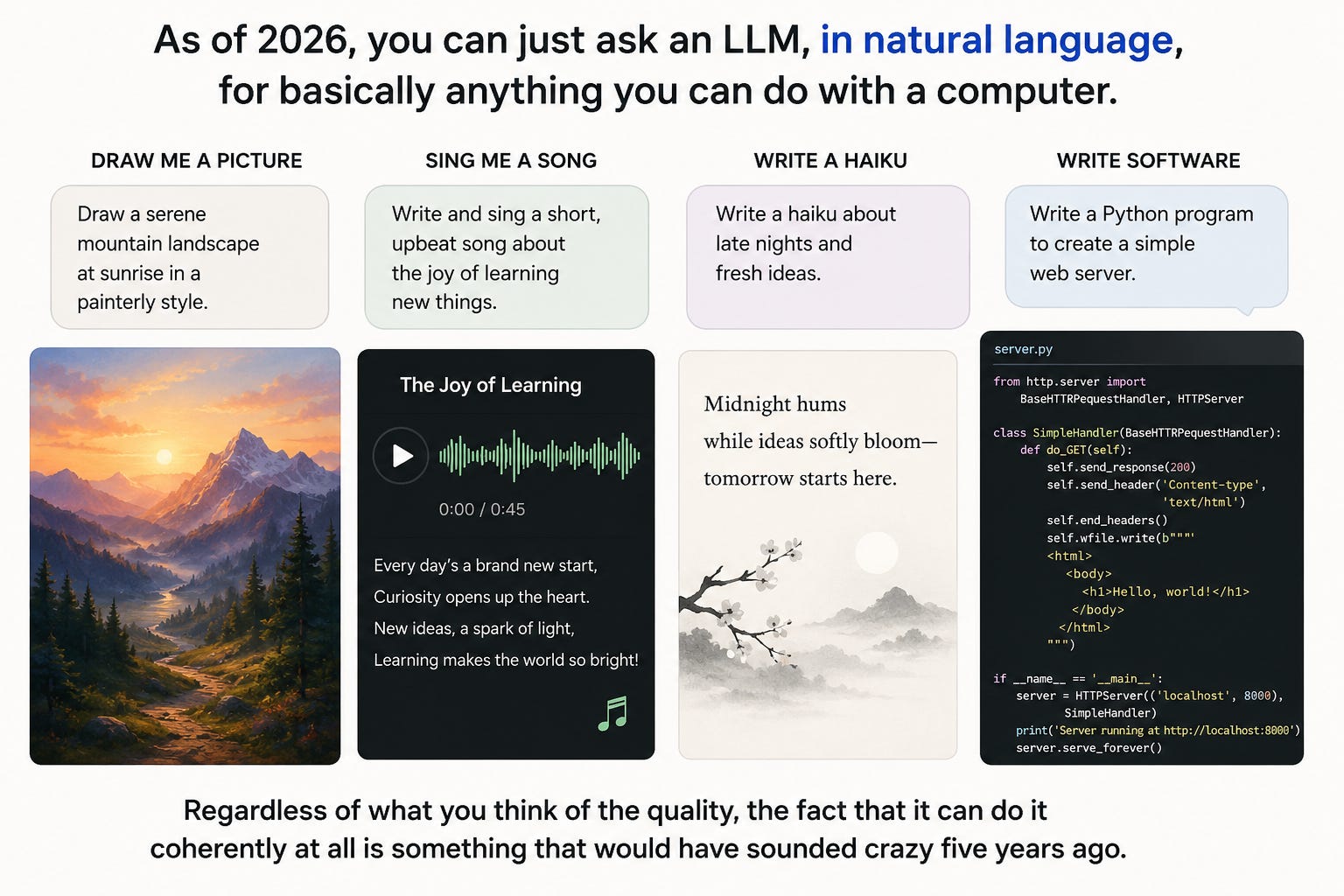
If you look carefully, the haiku is completely wrong.
Conversely, that’s definitely a mountain landscape at sunrise, and the Python code will actually fire up a simple local website saying “Hello, world!”
Honestly, I think that sums up my thesis remarkably well - it’s really amazing what they can do today, but there’s also some fundamental obstacles to achieving all the crazy dreams people have of what these things can do.
That said: plenty of people predicted where the Internet was going, including downsides like corporate-controlled media, heavy censorship, political echo chambers, and so on.
If you have the right vantage point, it’s not hard to see the general shape of the future.
Seeing the Present
If you want to see the future, it helps to have an accurate picture of the present.
Four years ago we were laughing about AI being unable to get the number of fingers right in its artwork. The state of the art can generate accurate QR codes:


In fact, AI Art can pass a sort of Turing Test. Humans can’t actually distinguish a lot of LLM art - just the obvious slop stuff. And, you know, we can detect human slop too. Very few people get confused about the difference between Garfield and the Mona Lisa. (https://www.astralcodexten.com/p/ai-art-turing-test)
LLMs have even won a few minor literary and artistic prizes. I think this reflects more on the judges being unaware of what LLM art looks like, but that just reiterates the importance of paying attention. (https://ohiblog.com/art/ai-wins-state-fair-art-competition-sparking-debate for art, and https://www.vulture.com/article/granta-commonwealth-foundation-short-story-ai.html for the short story scandal.)
LLMs are increasingly being used on the frontiers of both art and science. Even if you hate their art style, they’re great for quickly drafting ideas and getting a feel for what works and what doesn’t - making it much easier to communicate your vision to an actual artist, who can then bring passion and soul to the composition. The same applies in engineering - you can rapidly iterate on ideas, find a few worth testing, and see which ones actually hold up.
It has solved multiple hard, long-standing mathematics problems. Don’t get this confused with the earlier one where an LLM solved a minor Erdos problem that was simply overlooked; this one is “the first AI proof that would likely be published in math’s top journal if humans had done it alone” (https://www.scientificamerican.com/article/ai-just-solved-an-80-year-old-erdos-problem-and-mathematicians-are-amazed/)
You don’t need perfection to be useful - speed is currently their real advantage.
Superhuman
Technology is often superhuman. A calculator can beat the best human mathematician. A car can beat the fastest sprinter.
Technology is also very jagged - a car can’t climb Mount Everest, and a backhoe lacks the delicacy for an archeological dig.
The Industrial Revolution automated manual labor, but it didn’t obsolete manual labor. There are plenty of places where hand-crafted goods are preferred, or even cheaper and easier to make. The best manufacturing processes are often a mix of humans and machines, leaning into the strengths of both.
We’ve already seen Claude Code reach superhuman capabilities at programming. Before Mythos, you could quibble over benchmarks, but it’s now unequivocal: you can do more with Claude Code than even the best humans could accomplish in similar time frames. Thanks to Project Glasswing, we can see that Mythos was somewhere between a 5-20x improvement in Firefox’s ability to find bugs, including numerous high-severity security issues (https://hacks.mozilla.org/2026/05/behind-the-scenes-hardening-firefox/ for the full report)
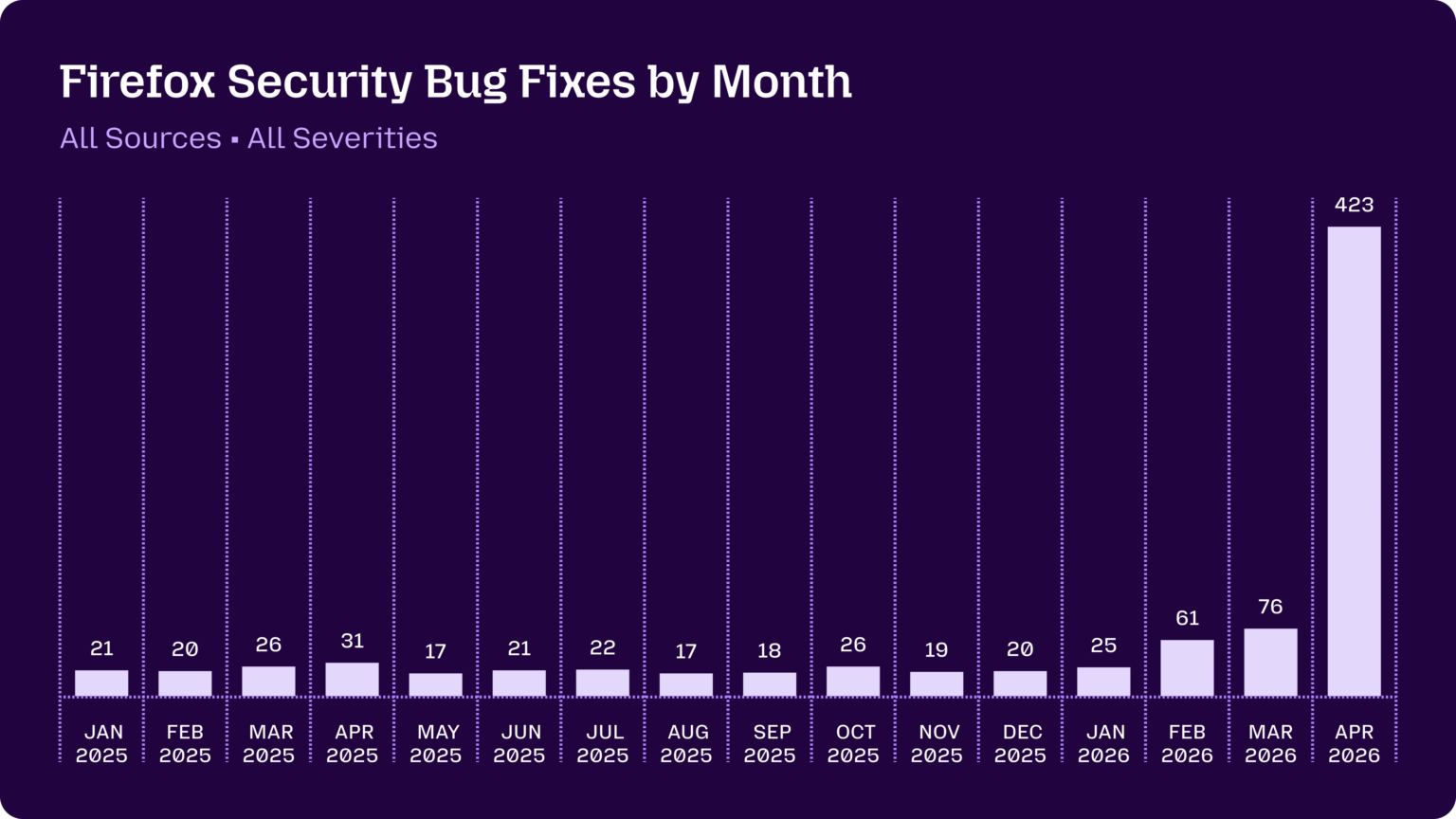
For a broader view, there’s also the Epoch graphs - basically the same curve, but across 17 major vendors and 4 major open source programs. These benefits are not exclusive to Firefox or browsers - we’re seeing them across the industry (https://epoch.ai/data/cve?view=graph)
We are on the precipice of automating intellectual labor, the way factories automated manual labor.
Future Shock
I’m asking you to take in a few radical ideas, here.
We have already entered the Cyberpunk Era, and I don’t think people are letting that really sink in. Trillionaire Mega Corporations, Self-Driving Cars, and Talking Computers are all very much real. If you had told someone about this 25 years ago, they would have probably called your timelines extremely unrealistic.
I’m not saying that they’re particularly good, in either the moral or useful sense.
I am saying:
The future arrived when we weren’t looking.
This is just the start of the ride.
Post-Script: Timeline
If you’re still with me, the next post is “National Security Concerns”
Otherwise, I think timelines thus far are the most convincing evidence I can offer for this being a major revolution. Personally, this all screams “we are speeding up, not slowing down”:
Ancient history: In 1997, Deep Blue beat the world champion, Kasparov, at chess - one of the first times a computer was superhuman at something other than raw math. Experts were impressed, but there were obviously limits: chess has a narrow possibility space, and a computer can “brute force” the game by testing millions of possible moves each turn. Surely, the experts said, a computer can never win at a more open-ended game like “Go” which resists such brute force attempts.
Neural nets were the next breakthrough - computers that can learn from experience and master skills via practice, not dissimilar to how humans do. In 2016, this led to DeepMind defeating the world champion Go player, Lee Sedol. This was a lot more surprising - Chess was an expected outcome, but “learning from experience” was a much bigger departure from conventional computing.
In 2022, the public was introduced to ChatGPT - a computer fluent not at games, but at language itself. Once again, this was a huge surprise to basically everyone except the writers of bad science fiction. Almost overnight, an entire trope went from laughably naive to a lived reality. It took 19 years to go from Chess to Go. It only took 6 years to jump from a well-defined area like gaming, to the wild west of language.
As of 2026, you can just ask an LLM, in natural language, for basically anything you can do with a computer. It can draw you a picture, sing you a song, write haikus, and code its own software. Regardless of what you think of the quality, the fact that it can do it coherently at all is something that would have sounded crazy five years ago.
The future is unfolding right now - it’s just a question of when quality becomes sufficient for the tasks we want to use it for.